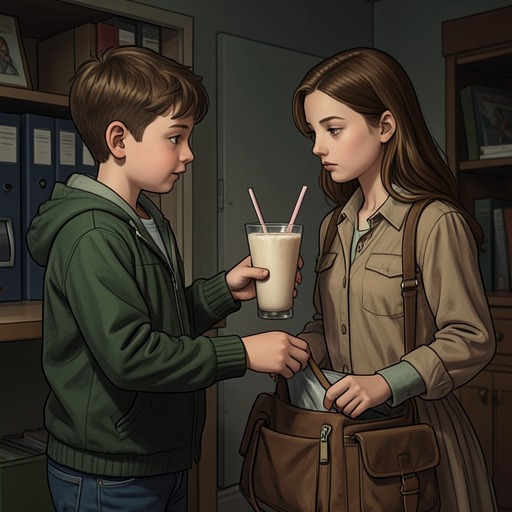
Hannah Baker—Zach Dempsey
Thirteen Reasons WhyHannah Baker and Zach Dempsey are linked by two sharply contrasting moments: an awkward, almost comic encounter outside Hannah’s former home, and a later scene at Rosie’s Diner in which Hannah looks to Zach for help as Marcus Cooley touches her without consent. The contrast gives their relationship its significance. Zach is first a boy who falls into view while trying to glimpse Hannah; later, he is one of the people who see her distress and do not intervene.
The Encounter at Hannah’s Former Home
During the summer, Hannah and Kat sit talking for hours in the bay window of Hannah’s old house. Zach approaches with another friend, walking up the middle of the road where two streets meet in front of the house. Hannah’s memory singles him out by name, making the scene an early point of contact between the two.
Zach steps out of the gutter and onto the lawn to get a better view through the window of Kat’s new friend: Hannah. The grass is wet from the sprinklers, and his foot slips forward, sending him into a split. His friend, who has been staring at the window, trips over him and lands beside him at the curb. Zach pushes his friend off and gets back up; the two boys look at each other, uncertain what to do, before running back down the street. Kat and Hannah laugh from the window. The encounter is an embarrassing glimpse rather than a conversation: Zach is physically close to Hannah’s home, but he and Hannah remain separated by the window.
Zach at Rosie’s Diner
The later encounter takes place during Hannah’s date with Marcus at Rosie’s Diner. As Marcus pulls her close and puts a hand on her upper thigh, Hannah looks over the booth toward the other booths and the counter, trying to catch someone’s eye. A few people glance over, then turn away. Her fingers struggle beneath the table to pry Marcus’s hand off and push him away; she does not want to yell, but her eyes are begging for help.
Hannah emphasizes that no one asks whether there is a problem. She directly addresses Zach, asking whether he, too, was merely being polite. The question makes his presence distinct from the anonymous looks elsewhere in the diner: in Hannah’s account, Zach is someone she identifies as having had the chance to recognize that something was wrong, yet he does not come to her aid.
Silence, Recognition, and the Tapes
The first memory returns when the later scene prompts an unwanted chain of recognition. Hannah recalls Zach falling on her lawn alongside other occasions when his presence intersects with her history, including his interruption of a conversation between her and Clay Jensen at Kat’s going-away party. The recollections do not establish a close relationship between Hannah and Zach; instead, they show how a familiar face can recur across apparently separate episodes in her story.
At Rosie’s, Hannah’s words are unmistakable: “Stop it,” she says to Marcus, close enough that her mouth is inches from his ear. Marcus hears her, but the account then turns to the people who do not answer her unspoken request for help. Zach’s failure to act is presented within that wider pattern of bystanders looking away, not as an intervention or a confrontation between him and Hannah.
Significance of Their Relationship
The window-side fall and the diner-side silence form an uneasy reversal. In the first scene, Zach’s attempt to look at Hannah ends in public embarrassment, witnessed from a safe distance by the girls in the window. In the second, Hannah is the one seeking to be seen, and the people who notice her distress avert their eyes. The earlier incident makes Zach recognizable when Hannah invokes him; it does not excuse or explain his later inaction.
Through this relationship, the account distinguishes being visible from being helped. Hannah and Zach have crossed paths before, but familiarity alone does not produce care: when Hannah looks toward him during Marcus’s unwanted touching, she receives no response. His silence becomes part of the evidence Hannah recounts about the failure of those around her to intervene.